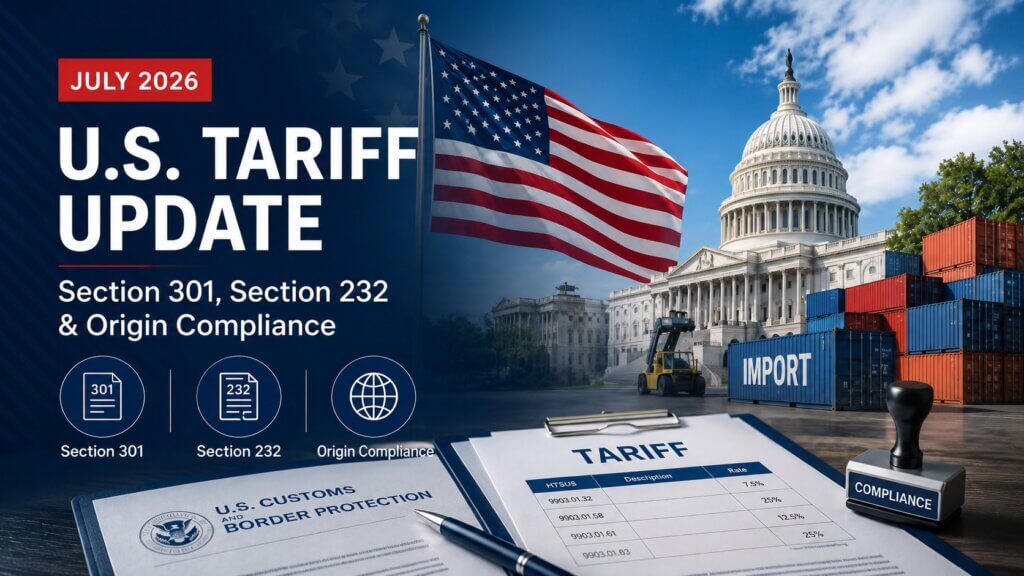
As of July 2026, U.S. tariff policies are still being adjusted. For those involved in U.S. logistics, customs clearance, or freight quotations, the following points are especially important:
1. Base Tariffs on Global Imports Remain Subject to Change
The U.S. government continues to revise its reciprocal tariff policy. Some previously imposed tariffs have faced legal challenges, while the government is also considering alternative legal authorities to support new tariff measures. As a result, the policy environment remains highly fluid.
2. Chinese-Origin Goods Still Face Higher Tariffs
Many products imported from China remain subject to additional duties, including Section 301 tariffs. Although certain measures have been adjusted through ongoing trade negotiations, the overall tariff level on Chinese-origin goods remains higher than the normal Most-Favored-Nation rate.
3. Stricter Scrutiny of Transshipment Through Vietnam, India, and Other Countries
U.S. Customs continues to strengthen enforcement against illegal transshipment and origin evasion.
If Chinese-origin goods are routed through a third country, such as Vietnam, without substantial transformation or proper compliance with the rules of origin, the shipment may be subject to higher tariffs, penalties, or additional investigation.
CBP is also reviewing country-of-origin documentation more carefully.
4. Steel, Aluminum, and Certain Industry-Specific Products
Certain steel, aluminum, automotive, technology, and other industry-specific products may still be subject to additional tariffs, such as Section 232 duties.
Some countries and importers may request exclusions or exemptions, but these measures have not been fully removed.
5. Key Points for U.S. Importers
Before shipment, U.S. importers should:
- Confirm the latest HTS classification.
- Check whether Section 301, Section 232, or other additional duties apply.
- Confirm whether the product is subject to anti-dumping or countervailing duties.
- Maintain proper country-of-origin documentation.
- Avoid any routing arrangement that may be considered illegal transshipment.
- Allow for possible tariff changes when preparing quotations.
Impact on Logistics and Customs Operations
For shipments from China, Vietnam, Taiwan, or other Asian countries to the United States, the main items to review are:
- Whether the importer needs to recalculate the estimated duty.
- Whether Section 301 tariffs apply.
- Whether the product is subject to Section 232 duties.
- Whether anti-dumping or countervailing duties apply.
- Whether CBP may request additional origin verification.
- Whether the declared country of origin is properly supported.
For an accurate duty calculation, the following information is normally required:
- Product description
- HTS code
- Country of origin
- Product material and intended use
- Manufacturer information